Story-driven web design is a way of building websites around the customer journey instead of random sections and generic layouts. It uses structure, messaging, visuals, and flow to guide people from interest to trust to action.
Instead of showing everything at once, a story-driven website gives visitors the right information at the right time. It helps them understand who you are, what problem you solve, and why they should choose you.
Most websites fail because they feel disconnected. They jump from one section to another without a clear message. A story-driven website feels easier to follow. When people understand your story, they trust you faster, remember you longer, and feel more ready to take action.
Why Story-Driven Web Design Feels Different
Most websites are built like checklists. They have a hero section, some service boxes, a few testimonials, and a contact form. Everything is there, but nothing connects.
Story-driven web design works differently. Every section has a purpose. Each part leads naturally into the next. Instead of throwing information at people, the website guides them through a clear journey.
A good story-driven website usually follows a simple flow:
- What problem the customer is facing
- Why that problem matters
- How the business can help
- What makes the business different
- Why the visitor should trust them
- What action to take next
Each section should lead naturally into the next one. The visitor should never feel lost or forced to guess what comes next.
For example, if someone lands on a law firm website, they should quickly understand what type of cases the firm handles, who it helps, what the process looks like, and how to get started.
The same idea applies to any business. A restaurant website should make it easy to understand the menu, the atmosphere, and how to book a table. A marketing agency website should explain the problem, the service, the proof, and the next step.
When a website follows a story, people spend less time figuring things out and more time deciding what to do.
This is why story-driven websites feel easier to read. People do not have to work hard to figure out what the business does or why it matters.
Template-based websites often look polished, but they can feel empty. They rely on stock phrases, generic layouts, and the same structure everyone else uses. They may look good for a few seconds, but they do not leave a lasting impression.
A story-driven website gives people a reason to care. That is what makes it different.
If you want to see how this works in practice, explore our story-driven web design services at Les Creatifs Studio.
Why Most Websites Fail Today
Most websites do not fail because of bad colors or poor fonts. They fail because they do not make people care.
Many business websites try to say too much at once. The homepage talks about ten different services. The messaging is vague. The layout feels scattered. Visitors land on the page and do not know where to look first.
Other websites have the opposite problem. They look modern, but they say almost nothing. There is a big image, a short headline, and a few generic phrases like “we help businesses grow” or “your trusted partner.” Those words could belong to almost any company.
When people cannot quickly understand what a business does, who it helps, and why it matters, they leave.
This happens faster than most business owners realize. People often decide within a few seconds whether they want to stay on a website or leave it.
If the homepage feels confusing, overloaded, or too generic, they stop paying attention. They go back to Google, open another website, and compare you with someone else.
That means your website is not only competing against bad design. It is competing against short attention spans.
Many businesses also make the mistake of copying competitors. They use the same layouts, the same stock photos, and the same language. After a while, every website in the industry starts to look the same.
That creates a bigger problem. If your website looks like everyone else’s, people have no reason to remember you. And if they do not remember you, they compare you on price alone.
Most founders think a website should simply look professional. But looking professional is not enough anymore. People want clarity. They want to know if you understand their problem. They want proof that you can help.
This is why so many websites do not convert. They are built around the business instead of the customer. They talk about features, services, and company history before they explain why any of it matters.
If you want to understand this problem more deeply, read our guide on why some websites do not convert.
The Psychology Behind Storytelling in Web Design
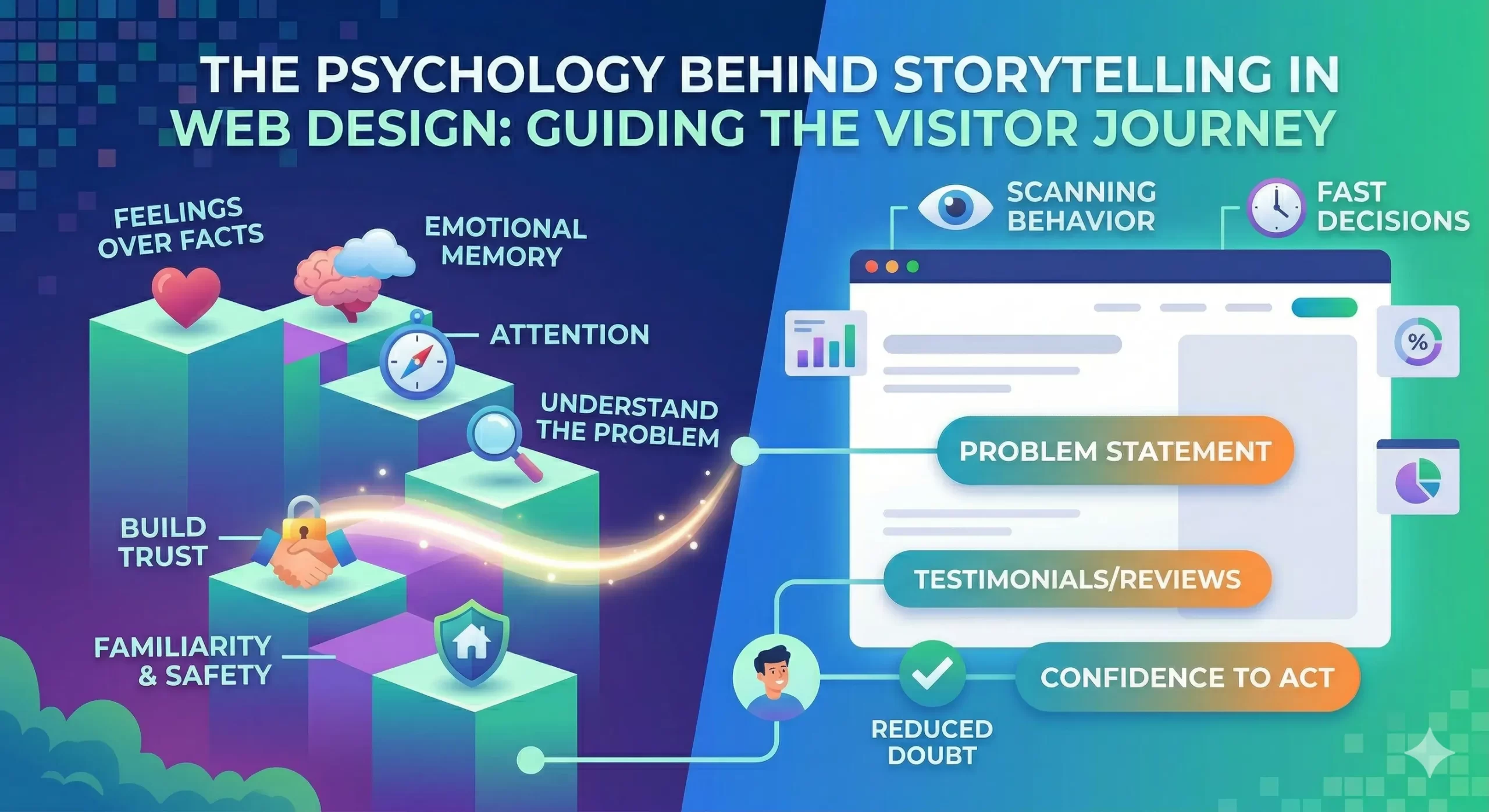
Psychology in action: Using narrative structures to bypass technical confusion and build immediate user trust.
People do not remember every detail on a website. They remember how the website made them feel.
A story helps people pay attention because it creates a clear path. Instead of jumping between random sections, visitors move through the page step by step. They understand what problem they have, why it matters, and what to do next.
Story also builds trust. When a website speaks directly to a visitor’s problem, it feels more personal. People want to feel understood before they buy, book, or contact a business.
And people trust what feels familiar. A website with a clear message, simple structure, and real examples feels safer than a website full of vague claims and generic language.
Stories are easier to remember than lists of features. Someone may forget a technical detail about your service, but they will remember a simple message that explains how you helped someone like them.
Most people do not read websites from top to bottom. They scan. They look for signals that tell them they are in the right place. A clear story makes that easier. It removes confusion and gives people confidence.
A clear story is only one part of conversion. You can also read our guide on what makes a website high-converting.
When visitors feel confused, they delay decisions. When they feel clear, they move faster. That is why good storytelling is not just about emotion. It is also about reducing doubt.
Research from Nielsen Norman Group has shown that people scan websites quickly and decide within seconds whether to stay or leave.
That is why trust matters so much. If people do not trust your website, they will not take the next step. You can read more in our guide on what makes a website trustworthy.
How Story-Driven Web Design Improves Conversion
A website converts better when people know what to do next.
Story-driven web design creates that clarity. Instead of giving visitors too many choices, it moves them through a simple path. First, they understand the problem. Then they see the solution. Then they see proof. Then they take action.
That flow matters because most people do not make decisions right away. They need time to understand what you do and why it matters to them.
A good story keeps people moving through the page. Each section answers the next question in their mind. That creates momentum.
For example:
- A strong headline gets attention
- A clear problem statement makes people feel understood
- A short explanation shows how you help
- Testimonials build trust
- A simple call to action tells them what to do next
Good conversion is usually not about pushing people harder. It is about making decisions easier.
Many business owners think conversion comes from stronger buttons, brighter colors, or bigger headlines. Those things can help, but they do not fix a weak message.
If people do not understand why your business matters, they will not convert. A story gives context to everything else on the page.
Without that flow, people get stuck. They scroll without direction. They hesitate. And when people hesitate too long, they leave.
Many websites ask visitors to do too much. Book a call. Download a guide. Follow on Instagram. Join a newsletter. View ten services. That creates friction.
A story-driven website focuses on one main action at a time. It gives people a clear next step instead of overwhelming them with options. When the path feels simple, people are more likely to follow it.
This is why story-driven websites often convert better than websites built around random sections and generic messaging. They reduce confusion and help people make decisions faster.
Trust is a big part of this. People are more likely to contact you, book a call, or buy when they feel confident in what they are seeing.
Websites that feel clear, honest, and easy to follow usually build trust faster than websites that feel confusing or generic.
Real-World Examples of Story-Driven Web Design
Story-driven web design can work for almost any type of business. The structure changes, but the goal stays the same. Help people understand, trust, and take action.
Startup Website
A startup website should explain the problem first. Many founders want to talk about features, funding, or product details too early.
But most visitors care about one thing first. What problem does this solve for me?
A story-driven startup website starts with the problem, then explains the solution, then shows why the product is different. After that, it adds proof like testimonials, client logos, reviews, or case studies.
Service Business Website
A service business website should make visitors feel understood.
For example, a law firm, agency, salon, or construction company should not start with a long paragraph about company history. It should start with the customer’s situation.
What are they struggling with? What do they need help with? Why should they trust this business over others?
Then the website can explain the process, show proof, answer common questions, and give people a clear next step.
Personal Brand Website
A personal brand website is often built around one thing – trust.
People want to know who you are, what you believe, and why they should listen to you. A story-driven website helps connect those pieces.
Instead of listing achievements and credentials in random sections, it creates a clear path. It shows your background, your values, your work, and the result you help people achieve.
This is also why story-driven websites often perform better across mobile devices. People scroll quickly on phones. They do not want to search for information or piece things together on their own.
A strong story gives mobile visitors the same clear path as desktop visitors. That matters because most businesses now get more than half of their website traffic from mobile devices.
A website should answer questions in the order people naturally ask them. What is this? Is it for me? Can I trust it? What should I do next?
That is why story-driven websites work across so many industries. They follow the way people already think.
Frequently Asked Questions
What is story-driven web design?
Story-driven web design is a way of building websites around the customer journey. Instead of showing random sections and generic information, it guides people through a clear path from problem to solution to action.
Is storytelling important in websites?
Yes. Storytelling helps people understand what a business does, why it matters, and why they should trust it. A website with a clear story feels easier to follow and easier to remember.
Does storytelling improve conversions?
In many cases, yes. Storytelling can improve conversions because it reduces confusion. It gives people the right information in the right order, which makes them feel more confident about taking action.
Why do some websites not convert?
Many websites do not convert because they focus too much on the business and not enough on the customer. They talk about services, features, and company history before they explain why any of it matters.
When people do not quickly understand what you do, they leave. A clear story helps remove that confusion and gives people a reason to stay.
Final Takeaway
A website should do more than look good. It should help people understand, trust, and take action.
That is why story-driven web design matters. It gives your website structure. It makes your message easier to follow. And it helps people feel something before you ask them to buy, book, or contact you.
Most websites focus too much on sections, layouts, and features. But people do not remember sections. They remember stories.
If your website does not make people care, it will not make them act. The businesses that win are usually the ones that make people feel understood first.
If you are planning a new website, you may also want to read whether a one-page website is enough for a small business.
The post What Is Story-Driven Web Design? A High-Converting Website Design Strategy Explained appeared first on Best Media Agency.
]]>Web design trends are not just about aesthetics—they reflect changing consumer behaviors, technological advancements, and digital innovations. A well-designed website enhances user experience, builds trust, and improves business outcomes. Ignoring these trends can result in outdated designs, slow-loading pages, and a frustrating user experience that drives potential customers away.
For designers, staying updated means mastering new design principles, tools, and interactive elements. Marketers must understand how web design influences user behavior, engagement, and conversion rates. Business owners need to invest in websites that attract and retain customers while strengthening brand identity.
In 2025, several key trends will dominate the digital landscape. Minimalist layouts, dark mode, immersive animations, AI-driven user experiences, and bold typography are leading the way. These trends prioritize usability, accessibility, and engagement while ensuring a seamless browsing experience. From micro-interactions to AI-powered chatbots, web design is evolving to become more interactive and user-focused.
This article explores the most influential 2025 website design trends and how they are setting new standards. We’ll break down their significance, implementation strategies, and potential impact. Whether you’re a designer, marketer, or business owner, understanding these trends will help you stay ahead in an increasingly competitive digital space.
The Driving Forces Behind 2025 Web Design
These 2025 website design trends are driven by rapid technological advancements. Over the years, web design has evolved from static pages to highly interactive, AI-powered experiences. As user expectations continue to rise, businesses must stay ahead by adopting trends that improve both aesthetics and functionality. Moreover, with increasing competition online, brands can no longer afford to rely on outdated designs.
Evolution of User Experience
User experience (UX) has changed significantly over the last decade. In the beginning, websites were primarily text-based with limited functionality. However, as technology advanced, the focus shifted toward better navigation, mobile responsiveness, and visually engaging elements. Today, AI-driven personalization, micro-interactions, and immersive interfaces define the modern web.
Furthermore, users now expect dark mode, minimalistic layouts, and smooth animations to enhance readability and navigation. At the same time, the rise of voice search and AI chatbots has made websites more interactive, allowing visitors to find information faster. Instead of just being visually appealing, modern websites must anticipate user behavior and provide personalized, real-time solutions.
Technology’s Role in Web Design
The web design landscape is undergoing a major transformation, largely due to emerging technologies such as AI, AR/VR, automation, and Web 3.0. These innovations are not only making websites smarter but also significantly improving user engagement.
- Artificial Intelligence (AI): AI is reshaping web design by automating content creation, optimizing layouts, and enhancing user interactions. For example, AI-driven tools can generate personalized experiences based on user preferences, making websites more engaging. According to Forbes, AI-powered websites are helping businesses improve efficiency and user satisfaction.
- Augmented & Virtual Reality (AR/VR): AR and VR are revolutionizing industries such as retail and real estate by offering virtual try-ons and interactive property tours. As a result, customers can experience products and spaces before making a purchase, leading to higher engagement and conversions.
- Web 3.0 & Decentralization: With the growing adoption of blockchain technology and decentralized applications (dApps), data control is shifting back to users. Consequently, this trend enhances security, transparency, and privacy, making websites more trustworthy and reliable.
Business Impact: Why Brands Are Investing in Cutting-Edge Web Aesthetics
A website is no longer just a digital brochure—it’s a critical business asset. Companies investing in modern web design trends gain several competitive advantages:
✔ Higher conversion rates, thanks to intuitive, action-driven layouts.
✔ Stronger brand recognition by maintaining a consistent and visually appealing identity.
✔ Better search engine rankings, as Google prioritizes mobile-friendly, fast-loading, and user-centric websites.
✔ Increased accessibility, ensuring websites cater to users of all abilities.
On the other hand, businesses that fail to adapt risk losing potential customers to competitors with more engaging, faster, and immersive websites. Therefore, staying updated with these 2025 website design trends is no longer optional—it’s a necessity for long-term success.
Industry-Defining Website Design Trends
Industry-defining 2025 website design trends prioritize user experience. As businesses compete for attention in a crowded digital space, the focus has shifted toward designs that enhance usability, accessibility, and engagement. Therefore, websites that fail to meet modern expectations risk higher bounce rates and lower conversions. As a result, the trends shaping 2025 will help businesses stay ahead by creating seamless, visually compelling, and interactive experiences.
1. Mobile-First & Responsive Design
With mobile traffic surpassing desktop usage, mobile-first design is no longer optional—it’s essential. Consequently, websites must be optimized to deliver a fast, intuitive, and visually appealing experience on small screens. Furthermore, a well-optimized mobile site can improve user retention and brand credibility.
- Fluid grids and flexible layouts ensure content adapts seamlessly across devices.
- Touch-friendly navigation enhances usability by making buttons and menus more accessible.
- Faster loading speeds are prioritized, as mobile users expect near-instant responses.
- Progressive Web Apps (PWAs) bridge the gap between websites and native mobile apps, offering offline functionality and app-like experiences.
Since Google’s mobile-first indexing makes responsive design a ranking factor, businesses investing in mobile-first strategies will see higher engagement and better SEO rankings. Moreover, companies focusing on seamless mobile experiences will improve customer satisfaction and retention.
Over time, mobile-first design will evolve into an AI-driven adaptive experience, where websites dynamically adjust based on user behavior and device preferences in real time. Additionally, voice-activated navigation and gesture-based interactions will become more prevalent, making mobile browsing more intuitive.
2. Minimalism & Clean Aesthetics
Less is more in modern web design. Minimalism focuses on simplicity, clarity, and functionality, ensuring users can find what they need without distractions. Consequently, businesses adopting minimalistic designs create more engaging and effective digital experiences. Additionally, minimalist aesthetics improve website performance by reducing unnecessary elements that slow down page speed.
- Whitespace and clean layouts improve readability and navigation.
- Limited color palettes create a cohesive and sophisticated look.
- Typography-driven designs prioritize content hierarchy for better user experience.
- Grid-based structures help maintain balance and proportion in the layout.
Minimalist websites load faster, reduce cognitive overload, and keep users focused on key actions, ultimately boosting conversions. Apple, Google, and Airbnb are prime examples of brands leveraging minimalist design to great success. Moreover, as users crave simplicity, minimalist aesthetics will continue to be a defining trend.
Looking ahead, the next phase of minimalism will introduce AI-generated adaptive design, where websites adjust font sizes, color schemes, and layouts based on real-time user data, making the experience hyper-personalized. Additionally, voice-based minimalist UIs will gain traction, reducing reliance on complex menus.
3. Dark Mode & High-Contrast UI
Dark mode continues to gain popularity as users demand eye-friendly and stylish interface options. It offers multiple benefits, including improved accessibility and extended device battery life.
- Reduces eye strain, especially in low-light conditions.
- Improves battery life on OLED screens.
- Enhances visual contrast, making design elements pop.
- Creates a modern and sleek appearance, preferred by tech-savvy users.
In 2025, more brands will integrate dark mode as a user-selectable feature, offering greater customization and accessibility. Additionally, high-contrast UI designs will improve readability for users with visual impairments, aligning with Web Content Accessibility Guidelines (WCAG) standards. Moreover, dark mode settings will likely become more intuitive, adapting automatically based on user preferences.
In the future, adaptive dark mode will become standard, allowing websites to automatically adjust brightness and contrast based on the user’s ambient lighting and screen time. Additionally, customizable dark themes will allow users to fine-tune darkness levels based on personal preference.
4. Micro-Interactions & Motion UI
User engagement is heavily influenced by how websites respond to interactions. Therefore, micro-interactions and motion UI enhance digital experiences by providing feedback and guiding users seamlessly. Furthermore, animations help build emotional connections with users, making interactions feel more human and engaging.
- Hover effects, animated buttons, and scrolling cues make navigation intuitive.
- Loading animations and transition effects add a polished, dynamic feel.
- Lottie animations offer lightweight, high-quality motion graphics.
- Parallax scrolling adds depth by creating an illusion of movement as users scroll.
For beginners, implementing simple hover animations can improve user experience without requiring advanced coding. For experienced designers, incorporating JavaScript libraries like GSAP or Framer Motion can elevate websites with complex animations while maintaining smooth performance. Furthermore, adding thoughtful motion elements enhances storytelling and brand identity.
In the coming years, AI-driven motion UI will tailor micro-interactions based on user engagement patterns, dynamically adjusting animation speed and style for different demographics. Additionally, haptic feedback elements may be incorporated into web experiences, allowing users to “feel” interactions through vibrations on touch-enabled devices.
Cutting-Edge Website Design Trends
These cutting-edge 2025 website design trends push creative boundaries. As businesses look to stand out in an increasingly digital world, designers are embracing innovative aesthetics and interactive elements. The following trends redefine user engagement and digital storytelling, making websites more immersive, dynamic, and personalized.
5. Neumorphism & Brutalist Design
Neumorphism and Brutalism offer two vastly different yet equally impactful design approaches.
- Neumorphism blends realism and minimalism, creating a “soft UI” effect that makes interface elements appear subtly extruded from the background. This design trend enhances user experience by providing:
- Subtle shadows and highlights that create depth and a tactile feel.
- Minimalist, semi-flat visuals that maintain clarity while adding dimension.
- Smooth transitions and soft edges that make interactions feel intuitive.
- Brutalist Design, on the other hand, takes a raw, unpolished approach that breaks conventional aesthetics. Characteristics include:
- Bold typography and clashing colors that grab attention instantly.
- Asymmetrical layouts and hard edges that challenge traditional design norms.
- Unfiltered, raw aesthetics that prioritize authenticity over polish.
While Neumorphism focuses on subtle elegance, Brutalism thrives on being loud and unconventional. Both styles will shape niche markets in 2025, catering to brands that want to stand out either through sleek sophistication or raw, rebellious energy.
6. Immersive 3D & Augmented Reality Elements
Websites are no longer static; they are transforming into dynamic, immersive experiences. The integration of 3D elements and Augmented Reality (AR) enhances user interaction by offering:
- Realistic product visualizations, allowing customers to explore items from different angles before purchasing.
- Interactive storytelling, where users can engage with moving scenes or characters.
- Enhanced navigation, using AR to overlay information in real-world contexts.
Brands in industries such as e-commerce, gaming, and real estate are already leveraging AR to provide highly engaging experiences. For example, furniture retailers use AR to let customers visualize products in their homes before purchasing. As technology advances, expect more websites to integrate real-time 3D rendering and interactive AR experiences, blurring the line between digital and physical spaces.
7. Dynamic & AI-Generated Content
Static content is becoming outdated. In 2025, AI-driven personalization and real-time content adaptation are taking over. Websites are increasingly using AI to generate content dynamically based on user behavior and preferences.
- AI-Powered Chatbots and Assistants improve customer engagement by providing real-time assistance.
- Personalized Content Feeds adjust based on user interactions, ensuring a tailored browsing experience.
- Automated UX Adjustments, such as adaptive themes and layouts, create a seamless user journey.
Brands utilizing AI-driven content will see higher engagement and improved conversion rates as visitors receive hyper-relevant experiences tailored to their needs. Additionally, AI-generated visuals and copywriting tools will enable faster content creation, reducing development time without sacrificing quality.
As AI continues to evolve, expect websites to become more self-optimizing, adapting dynamically to enhance user experience with minimal manual intervention. The future of web design lies in predictive, intelligent systems that anticipate user needs before they even express them.
Impact of These Trends on UX & Business Growth
How Trends Influence User Behavior & Conversions
Understanding how 2025 website design trends impact business growth is crucial. These evolving trends shape user experiences, directly affecting engagement, conversions, and customer satisfaction. A well-designed website encourages visitors to explore, interact, and take action.
- Improved Navigation & Accessibility: Intuitive layouts and seamless navigation reduce friction, leading to higher retention and lower bounce rates.
- Enhanced Visual Appeal: Aesthetically pleasing, modern designs build trust and credibility, making users more likely to convert.
- Faster Load Times & Performance: Speed optimization is essential—slow-loading pages lead to frustration and lost sales.
- Personalized Experiences: AI-driven content adaptation tailors user experiences, making interactions more relevant and effective.
- Micro-Interactions & Engagement: Interactive elements encourage users to take action, such as completing forms, making purchases, or sharing content.
As a result, businesses that embrace these trends see improved user engagement, increased dwell time, and stronger customer relationships, ultimately leading to higher conversion rates.
Brand Identity & Market Positioning
Modern web design trends don’t just enhance usability—they also play a vital role in branding and market positioning. A website serves as a digital storefront, reflecting a brand’s identity, values, and professionalism.
- Unique Visual Styles: Trends like Neumorphism, 3D elements, and dark mode create a distinctive brand image that stands out in a crowded market.
- Trust & Credibility: A well-structured, up-to-date website signals reliability and professionalism, fostering customer confidence.
- Competitive Differentiation: Brands that adopt cutting-edge designs position themselves as innovative leaders in their industry.
- SEO & Discoverability: Optimized, trend-driven websites rank better in search engines, attracting more organic traffic and potential customers.
By aligning web design strategies with evolving trends, businesses strengthen their digital presence and solidify their competitive edge. Companies investing in user-centric, forward-thinking design approaches will drive customer loyalty and long-term growth.
Implementation Challenges & Considerations
Adopting the latest web design trends can elevate user experience and business performance. However, implementing them comes with challenges that businesses must navigate carefully.
Technical Limitations & Compatibility Issues
New design elements, such as AI-generated content, immersive 3D visuals, and motion UI, demand advanced development skills and high-performance servers. Small businesses relying on budget hosting or outdated platforms may struggle with slow load times and incompatibility across devices. To avoid these pitfalls, companies should conduct rigorous testing and ensure their tech stack supports modern innovations.
Furthermore, working with a professional web design agency can help businesses integrate cutting-edge features without compromising performance. For those unsure where to start, The Ultimate Guide to Choosing the Right Website Design Agency offers insights on selecting the right partner.
Budget Constraints for Small Businesses
While large corporations have the resources to invest in AI, AR, and dynamic content, small businesses often face budget limitations. Fortunately, not every trend requires significant investment. Minimalism, mobile-first design, and strategic use of micro-interactions can enhance user experience without overwhelming costs. Businesses can prioritize features that align with their target audience and business goals.
For startups and small business owners looking for cost-effective solutions, How to Make Your Own Website Fast and Hassle-Free provides practical tips for building a high-performing website on a budget.
Ensuring Accessibility & Compliance
As design trends evolve, maintaining accessibility remains crucial. High-contrast UIs, voice navigation, and adaptive interfaces must cater to users with disabilities. Ignoring accessibility not only alienates a portion of the audience but can also lead to legal repercussions. Adhering to Web Content Accessibility Guidelines (WCAG) ensures that websites remain inclusive while leveraging modern design trends.
Measuring Success (KPIs, Bounce Rate, Engagement)
To determine whether a new design strategy is effective, businesses should track key performance indicators (KPIs) such as:
- Bounce Rate: A high bounce rate may indicate usability issues.
- Conversion Rate: Design improvements should lead to increased sign-ups or sales.
- User Engagement: Metrics like time on page and interaction rates reveal how engaging a website is.
By consistently analyzing data, businesses can refine their web design approach and ensure trends are implemented in ways that genuinely enhance performance.
Actionable Strategies for Adopting 2025 Website Design Trends
Staying ahead in the digital landscape means more than just following trends—it requires a strategic approach. Moreover, leveraging 2025 website design trends effectively demands the right strategy, tools, and alignment with business goals. Therefore, here’s how businesses can successfully implement these trends.
Step-by-Step Implementation Guide
- Analyze User Needs: Before adopting any design trend, assess your audience’s preferences and behavior. Furthermore, conduct surveys, analyze heatmaps, and review analytics to identify what works.
- Prioritize Mobile-First Design: Given the dominance of mobile browsing, ensuring your website is fully responsive and optimized for all devices is essential.
- Test Before Full Implementation: Introduce new design elements gradually and, in addition, use A/B testing to measure their impact on user engagement and conversions.
- Optimize for Speed & Performance: Trends like immersive 3D elements and animations should be implemented without compromising load times. Additionally, use tools like Google PageSpeed Insights to maintain optimal performance.
- Monitor & Iterate: Regularly track KPIs, including bounce rates, conversion rates, and engagement levels, to refine your design strategy over time. Consequently, ongoing optimization will ensure sustained success.
Best Design Tools & Platforms
Integrating cutting-edge trends requires the right set of tools. As a result, here are some top platforms that can help streamline the process:
- Figma & Adobe XD – For intuitive UI/UX prototyping and collaboration.
- Webflow & WordPress – Ideal for building and managing trend-driven, high-performing websites.
- Spline & Three.js – To incorporate 3D elements seamlessly.
- Lottie & GSAP – For smooth animations and motion UI enhancements.
- AI-Powered Tools – Platforms like MidJourney and ChatGPT for AI-generated design assistance.
Aligning Design with Marketing Goals
A visually appealing website is only effective if it aligns with broader business objectives. Therefore, to maximize impact:
- Enhance Brand Storytelling: Use design to create compelling narratives that resonate with your target audience. Additionally, storytelling strengthens emotional connections with users.
- Boost Conversion Rates: Implement strategic CTAs, interactive elements, and visually engaging content to drive user actions. Consequently, this improves sales and engagement.
- SEO Optimization: Design should support content visibility—ensure fast loading times, structured layouts, and mobile compatibility. Furthermore, search engine-friendly design enhances organic traffic.
- Consistent Branding: Maintain a uniform visual identity across platforms for cohesive brand recognition. In turn, this fosters customer trust and loyalty.
For those looking to craft engaging headlines that complement their web design strategy, check out Write Headlines That Captivate in Just 8 Seconds for expert tips on crafting compelling website copy.
By combining innovative 2025 website design trends with practical strategies, businesses can create visually stunning, high-performing websites that attract, engage, and convert visitors effectively.
Conclusion & Future Outlook
As digital landscapes evolve, staying ahead of design trends is essential for creating engaging, high-performing websites. The 2025 website design trends explored in this article highlight the increasing importance of user experience, immersive visuals, and AI-driven customization. Businesses and designers must adopt these trends thoughtfully, ensuring they align with brand identity, accessibility, and performance goals.
Looking ahead, the future of 2025 website design trends is dynamic and ever-evolving. Over the next five years, advancements in AI and machine learning will further personalize user experiences, making websites more intuitive and adaptive. The integration of AR/VR will transform how users interact with digital spaces, bridging the gap between physical and virtual environments. Sustainability will also become a crucial factor, with eco-friendly web design practices gaining traction.
For designers, marketers, and business owners, the key to long-term success lies in continuous learning and adaptation. Experimenting with new trends, leveraging innovative tools, and refining design strategies will help brands maintain a competitive edge. By embracing change and prioritizing user-centric design, businesses can create future-proof digital experiences that captivate audiences and drive success.
The post 2025 Website Design Trends That Will Set New Standards appeared first on Best Media Agency.
]]>