SEO helps your website rank in traditional Google search results. AEO, or Answer Engine Optimization, helps your content appear in featured snippets, voice search, and direct answers. GEO, or Generative Engine Optimization, helps AI tools like ChatGPT, Gemini, and Perplexity understand, summarize, and reference your content.
For years, businesses focused only on SEO. That still matters, but SEO alone is no longer enough.
People now search in different ways. Some use Google. Some use voice assistants. Some ask AI tools directly. Instead of clicking through multiple websites, many people now expect quick answers. That means businesses need visibility across Google, AI-generated answers, voice search, and answer engines.
What Is SEO?
SEO stands for Search Engine Optimization.
It is the process of improving your website so it appears higher in search results on Google and other search engines.
When someone searches for a service, product, or question related to your business, SEO helps your website get found. For example, if someone searches for “best accountant in Miami” or “website designer for startups,” strong SEO increases your chances of appearing near the top of the results.
Traditional Google rankings are based on how useful, relevant, and trustworthy your website appears.
Google looks at many signals before deciding where your page should rank. Some of the most important include:
- Keywords – The words and phrases people type into Google when looking for a product, service, or answer.
- Content quality – How useful, clear, and relevant your page is for the person searching. Google prefers content that answers questions and gives people what they need.
- Backlinks – Links from other websites pointing to your website. Google often sees these as trust signals because other websites are recommending your content.
- Technical SEO – The behind-the-scenes setup of your website, such as clean URLs, metadata, HTTPS, crawlability, and fixing broken links.
- Mobile experience – How easy your website is to use on a phone or tablet. Most people now search on mobile devices, so this matters a lot.
- Page speed – How quickly your website loads. Slow websites often lose visitors, increase bounce rates, and hurt rankings.
- Internal linking – Links between pages on your own website that help Google understand your content, topic relationships, and site structure.
SEO is still the foundation of online visibility. Even as AI search grows, Google rankings still influence who gets seen first. Businesses with strong SEO usually have a better chance of appearing in featured snippets, AI summaries, and answer engines too.
What Is AEO?
AEO stands for Answer Engine Optimization.
It is the process of creating content that can appear as a direct answer when someone asks a question online.
Traditional SEO focuses on helping your website rank in a list of search results. AEO focuses on helping your content become the answer itself.
You can see AEO in action when Google shows a featured snippet at the top of a search result, when a voice assistant reads an answer out loud, or when a search engine displays a quick answer box without requiring the user to click a website.
For example, if someone searches “What is SEO?” Google may show a short paragraph from a website directly at the top of the page. That is a featured snippet.
If someone asks a voice assistant, “How does SEO work?” the assistant may read a short answer from a website. That is also AEO.
AEO is becoming more important because people increasingly want immediate answers. They do not always want to visit multiple websites, compare pages, and spend time searching for basic information.
Instead, they want quick responses.
That is why question-based content is becoming more valuable.
Pages with headings like:
- What is AEO?
- How does voice search work?
- Why do AI tools choose some websites over others?
often perform better in answer engines.
FAQ sections are also useful because they match the way people search. Many users now type full questions into Google instead of short keywords.
For example, someone may search:
- Is SEO still worth it in 2026?
- What is the difference between SEO and GEO?
- How do AI tools find websites?
Strong AEO content is usually:
- Clear and easy to understand
- Written in short paragraphs
- Organized with question-based headings
- Supported by FAQ sections
- Easy for voice assistants and search engines to read
Businesses that structure their content this way have a better chance of appearing in featured snippets, voice search, answer boxes, and AI-generated summaries.
For a deeper look at this topic, read “What Is Answer Engine Optimization (AEO)?”
What Is GEO?
GEO stands for Generative Engine Optimization.
It is the process of creating content that AI tools can understand, trust, summarize, and reference.
Traditional SEO helps you rank on Google. AEO helps you appear in direct answers. GEO helps your business appear inside AI-generated responses.
You can see GEO in action when someone asks a question in ChatGPT, Gemini, Perplexity, or in Google AI Overviews.
Instead of showing ten blue links, these tools often generate a summary based on information they find across multiple websites.
For example, someone may ask:
- What is the difference between SEO and GEO?
- Which website platform is best for a startup?
- How do AI tools choose which businesses to reference?
AI tools look for content that is easy to understand and easy to trust.
They usually prefer websites that:
- Use clear headings
- Answer questions directly
- Stay consistent across pages
- Explain topics in simple language
- Link related pages together
- Show expertise and trust signals
Structured content matters because AI tools need to quickly understand what a page is about.
If a page is one long block of text with no headings, no clear sections, and no direct answers, it becomes harder for AI systems to use.
Trust also matters.
AI tools are more likely to reference websites that show real expertise, updated information, strong branding, clear author names, reviews, testimonials, and a consistent message across the website.
Topical authority matters too. If your business publishes several helpful pages around one topic, AI tools are more likely to see your website as a trusted source. A single blog post is often not enough.
For example, if your website publishes helpful content about SEO, AEO, GEO, AI search, and website strategy, AI tools are more likely to see your business as a trusted source in that area.
GEO is becoming more important because more people now ask AI tools for advice, recommendations, and summaries instead of only using traditional search engines.
For a deeper look at AI visibility, read “What Is Generative Engine Optimization (GEO)?”
SEO vs AEO vs GEO: Key Differences Explained
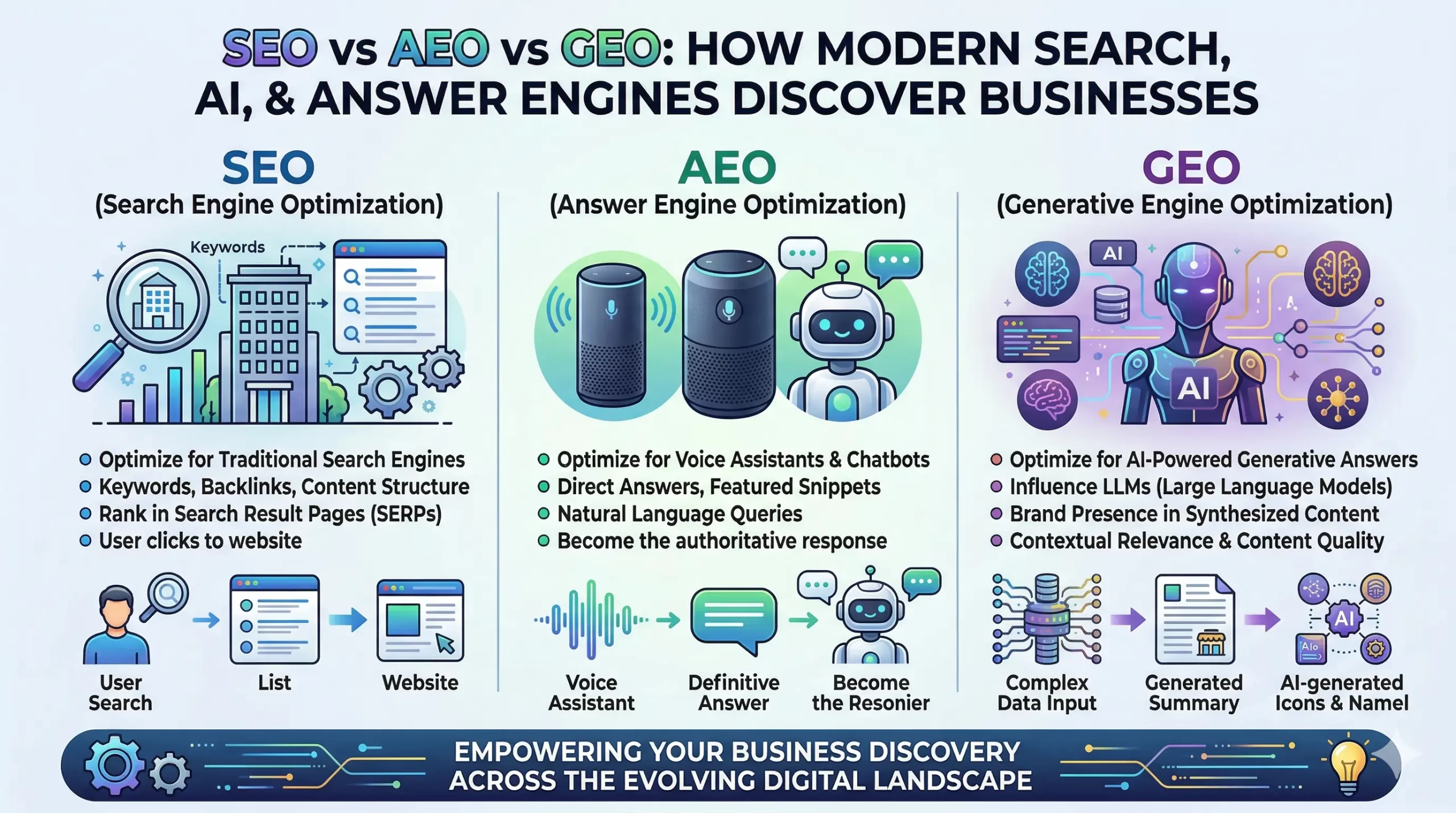
An overview of traditional Search Engine Optimization (SEO), Answer Engine Optimization (AEO), and Generative Engine Optimization (GEO).
SEO, AEO, and GEO all help people discover your business online. But they do not work in exactly the same way.
SEO focuses on helping your website rank in traditional search results on Google and other search engines.
AEO focuses on helping your content appear as the direct answer in featured snippets, voice search, FAQ sections, and answer boxes.
GEO focuses on helping AI tools understand, trust, summarize, and reference your content in AI-generated responses.
The easiest way to think about it is this:
- SEO helps people find your website
- AEO helps people find your answer
- GEO helps AI tools find and reference your business
They also overlap.
For example, a page with strong SEO usually has a better chance of appearing in AEO results because Google already sees it as useful and trustworthy.
A page with strong AEO structure may also perform better in GEO because AI tools prefer content that is easy to scan, easy to understand, and written in question-and-answer format.
Here is a simple breakdown:
- SEO is mainly about keywords, backlinks, technical SEO, and rankings
- AEO is mainly about question-based content, direct answers, FAQ sections, and featured snippets
- GEO is mainly about structured content, topical authority, trust signals, and AI visibility
You can also think of them by where they appear:
- SEO appears in traditional search results
- AEO appears in answer boxes, voice assistants, and snippets
- GEO appears in AI tools like ChatGPT, Gemini, and Perplexity
A business does not need to choose one over the other.
The strongest strategy is to use all three together.
For example, if you publish a page called “What Is Story-Driven Web Design?” you can:
- Use SEO to rank for the keyword
- Use AEO to answer common questions about story-driven design
- Use GEO to help AI tools summarize and reference the page
That is why SEO, AEO, and GEO should not be seen as separate strategies. They work best when combined.
Why Search Is Changing
Search does not work the same way it did a few years ago.
People are no longer only typing short keywords into Google and clicking through multiple websites.
Today, many people want answers immediately.
Google now shows AI Overviews for many searches. Instead of only showing a list of websites, Google often creates a summary at the top of the page using information from different sources.
Voice search is also growing.
People ask questions through Siri, Alexa, Google Assistant, and their phones in a more natural way. Instead of typing “best CRM software,” they may ask, “What is the best CRM for a small business with five employees?”
Chat-based search is growing too.
Many people now use tools like ChatGPT, Gemini, and Perplexity instead of traditional search engines.
Instead of getting a list of links, they get a direct answer, summary, recommendation, or comparison.
That means people are clicking less and reading summaries more.
People also search differently on mobile now. Many users do not scroll far down the page. If Google already gives them a quick answer through an AI Overview, featured snippet, or FAQ result, they may never visit another website.
This is called a no-click search.
For businesses, this creates a big shift.
A few years ago, ranking on page one of Google was often enough.
Now, a business may rank well but still miss out on visibility if its content is not showing up in featured snippets, voice search, AI Overviews, answer boxes, and AI-generated responses.
Traditional SEO still matters. But relying only on keywords and rankings is no longer enough.
Businesses that only focus on ranking may fall behind businesses that also create question-based content, strong FAQ sections, direct answers, and AI-friendly pages.
The businesses that stay visible in the future will be the ones that do more than rank.
They will be the ones that explain topics clearly, answer questions directly, and make their content easy for both people and AI tools to understand.
How AI Tools Discover Businesses
AI tools do not choose businesses randomly.
Tools like ChatGPT, Gemini, Perplexity, Claude, and Copilot all look for patterns when deciding which businesses, websites, and pages to mention.
They usually prefer businesses that explain topics clearly and consistently.
If your website is confusing, poorly structured, or says different things on different pages, AI tools may not trust it.
Structured content is one of the biggest factors.
AI tools prefer pages with:
- Clear headings
- Short paragraphs
- Bullet lists
- FAQ sections
- Tables
- Simple definitions
This makes it easier for AI systems to understand what your page is about.
For example, a page called “What Is SEO?” with a short definition, a few clear headings, and a FAQ section is much easier for AI tools to use than a long page with no structure.
Clear answers matter too.
AI tools often look for pages that answer a question directly in the first few lines.
For example, if someone asks “What is GEO?” the strongest pages usually define GEO immediately instead of making people scroll through long introductions.
Brand authority also matters.
AI tools are more likely to trust businesses that regularly publish helpful content around the same topic.
If your business writes one article about SEO and then never mentions it again, that may not build much authority.
But if your website includes content about SEO, AEO, GEO, AI search, website strategy, content structure, and answer engines, it creates a much stronger signal.
Trust signals are another major factor.
AI tools are more likely to reference businesses that show:
- Real author names
- Clear About pages
- Reviews and testimonials
- Case studies
- Updated information
- Consistent branding
- Contact details
- Industry expertise
AI tools also look for consistency across your website.
If one page says you are a web design company, another says you are a marketing agency, and another says you only focus on SEO, it can create confusion.
Strong businesses repeat the same core message across their homepage, service pages, blog posts, and About page.
Internal linking matters too.
When you connect related pages together, you help AI tools understand how topics relate to each other.
For example, a page about GEO could link to pages about SEO, AEO, AI Overviews, internal linking, and structured content.
That gives AI systems more context.
AI tools also trust businesses that go deeper into a topic.
A single article about SEO may not be enough. But if your website has several related articles around SEO, AI search, answer engines, website content, and brand authority, it becomes easier for AI tools to see you as a trusted source.
Consistent expertise is often what separates strong websites from weak ones.
AI tools usually trust businesses that stay focused on a few core topics and explain them well across multiple pages.
The businesses that win are often not the loudest. They are the clearest.
If your content is easy to understand, easy to trust, and easy to connect together, AI tools are more likely to discover and reference your business.
What Businesses Should Do Now
Most businesses do not need to rebuild their website from scratch.
But they do need to adjust how they create content.
The first step is to create better content.
That means writing pages that are useful, easy to understand, and focused on real customer questions.
Instead of writing generic blog posts, focus on topics your audience actually wants to know about.
The next step is to answer questions directly.
Use headings like:
- What is SEO?
- How does GEO work?
- Why do AI tools choose some websites over others?
Then answer those questions clearly in the first few lines.
Businesses should also build topical authority.
Instead of publishing random content on different subjects, focus on a few core topics and go deeper into them.
For example, if your business focuses on web design, you could publish related content about story-driven websites, SEO, AEO, GEO, branding, user experience, and conversion-focused design.
One good example is “What Is Story-Driven Web Design? A High-Converting Website Design Strategy Explained” because it helps build authority around web design, messaging, user experience, and conversions.
You can also link to “What Makes a Website High-Converting? Psychology, Structure, and Conversion Principles” because it supports topics like user experience, trust, page structure, and conversion-focused design.
Internal linking matters too.
Link related pages together so both Google and AI tools can understand the relationship between topics.
A page about GEO should naturally link to pages about SEO, AEO, AI Overviews, and AI search.
It is also important to publish trustworthy pages.
Use real author names, case studies, reviews, testimonials, updated information, and a clear About page.
Trust matters more now because AI tools want to recommend businesses that look reliable.
Most importantly, businesses need to think beyond Google rankings.
Ranking well is still valuable, but it is no longer the only goal.
Your content should also be able to appear in featured snippets, voice search, answer boxes, AI summaries, and AI-generated search results.
Final Takeaway
Search is no longer only about ranking on Google.
People now discover businesses through search engines, AI tools, voice assistants, featured snippets, and direct answers.
That is why SEO alone is no longer enough.
Businesses need content that ranks well, answers questions clearly, and helps AI tools understand and trust their expertise.
SEO helps people find your website.
AEO helps people find your answers.
GEO helps AI tools reference your business.
The businesses that stay visible in the future will be the ones that explain topics clearly, publish useful content, and build trust over time.
The future of discovery is not only about ranking.
It is about becoming the best answer.
The post SEO vs AEO vs GEO: How Modern Search, AI, and Answer Engines Discover Businesses appeared first on Best Media Agency.
]]>TL;DR – Quick Summary
Generative Engine Optimization (GEO) is the next evolution of SEO. It helps your content appear in AI-generated responses, AI-powered search engines, and tools like ChatGPT or Google’s AI Overviews. In 2025, traditional search engines are shifting from link-based results to direct summaries, voice replies, and structured answers.
GEO focuses on structured data, clear schema markup, and using consistent entities like tools, people, and topics. Instead of keyword stuffing, it leverages natural language processing, long-tail phrasing, and user intents to help large language models (LLMs) extract meaning.
If your content isn’t visible to AI models, your traffic suffers. By using GEO techniques, like creating llms.txt, aligning with content visibility standards, and structuring content for AI-native formats, you increase your chances of being featured in snippets and summaries.
Unlike traditional SEO, GEO is about creating content that AI can understand, trust, and use in real time.
What Is Generative Engine Optimization (GEO)?
Generative Engine Optimization (GEO) is the process of preparing your content so it can be easily read, understood, and reused by AI-powered search engines. These are search systems built on large language models (LLMs) that generate summaries and direct answers instead of just showing a list of links. For more on how these systems work, see Google’s AI developer documentation.
In traditional SEO, the goal is to rank higher on search results pages. You optimize for keywords, backlinks, and crawlability. GEO is different. It focuses on making your content ready for AI-generated responses. That means improving how your content is structured, how entities are defined, and how meaning is conveyed.
Instead of only asking “What’s my keyword density?”, you now need to ask:
-
Can an AI easily extract an answer from this section?
-
Is my content semantically labeled and well-organized?
-
Am I using structured data and schema markup?
GEO also prioritizes token efficiency. If your paragraphs are too long or filled with repeated phrases, AI engines may skip them. Clear, concise content with well-marked entities like “generative AI engines” or “natural language processing” helps systems index and retrieve your content faster.
You can think of GEO as an upgrade to SEO, not a replacement. It supports discoverability in a world where users interact with AI chatbots, voice assistants, and embedded search systems. The more AI-ready your content is, the more likely it is to be featured in snippets, summaries, and answer boxes.
In short, GEO helps your content show up where people are actually looking.
Why GEO Matters in 2025
Search has changed dramatically, and 2025 marks a turning point. We’re no longer browsing through ten blue links. More often, we’re speaking to virtual assistants, using AI search overlays, or relying on generative summaries that pull answers directly into the results.
This is exactly where Generative Engine Optimization (GEO) becomes critical.
The New Search Reality
AI-powered search engines, like Google’s Search Generative Experience (SGE) and Microsoft Copilot, don’t just index content. They interpret, summarize, and respond.
That means they’re not showing your link; they’re using your content to generate an answer. If your site isn’t structured in a way these engines understand, your traffic simply disappears.
In fact, many sites that once ranked on Page 1 are now completely invisible in generative results.
You might still be publishing, but no one is seeing it.
What’s Changing in 2025
GEO is your response to this disruption. Here’s why it matters now more than ever:
-
AI-generated answers dominate the top of the page
If your content isn’t part of that answer, you’re not just second—you’re nowhere. -
Voice search is growing fast
Generative models power virtual assistants. These systems prioritize content with clean structure, direct answers, and schema markup. -
Traditional SEO signals aren’t enough
Backlinks and keywords still help, but AI engines care more about clarity, semantics, and contextual depth. -
User behavior is shifting
People now expect instant answers, summaries, and takeaways. GEO helps your content meet that demand. -
Token efficiency impacts visibility
Long, repetitive content wastes space in an AI’s prompt window. GEO formatting ensures your content is efficient, scannable, and answer-ready. -
New entities matter
Adding references to “structured data,” “schema markup,” “AI-powered search engines,” and “natural language processing” improves your alignment with how AI understands topics.
Business Impact: Visibility = Opportunity
If you run a SaaS platform, agency, blog, or e-commerce store, GEO can dramatically shift your visibility curve. Instead of competing for clicks, you’re competing to be the answer.
By optimizing for generative search:
-
You reduce your dependence on ads
-
You increase your chances of appearing in snippets, voice answers, and featured AI overviews
-
You stay ahead while competitors cling to outdated tactics
It’s not just a ranking issue anymore. It’s a visibility issue, and that directly affects traffic, conversions, and growth.
What Happens If You Ignore GEO?
Let’s be blunt: Your rankings might not drop. But your visibility will.
Imagine this: your page is still indexed, your SEO tool shows no errors… but your traffic is flatlining. Why? Because AI is skipping your site. It doesn’t see it as useful, structured, or efficient.
GEO prevents that.

From keywords to AI-native structure.
How GEO Works (in the Context of SEO and AI)
GEO, or Generative Engine Optimization, is built for how modern search works. Search engines today aren’t just crawling pages. They’re reading, interpreting, and rewriting. AI-generated responses, summaries, and voice replies are becoming the new front page of the internet.
That means your content needs to do more than rank. It needs to be understood and reused by AI systems. GEO is how you make that happen.
AI Systems Process Meaning, Not Just Keywords
Traditional SEO focused on signals like backlinks, domain authority, and keyword stuffing. But AI-powered search engines don’t rely on those alone. They use large language models (LLMs) to understand what your page says, not just which terms you use.
These models don’t just match phrases. They extract intent and context using natural language processing (NLP). So, if your content is cluttered or too vague, it might be skipped. GEO helps you format content so machines can pick up on the meaning easily.
For example, instead of saying “we offer keyword research,” GEO content might explain how businesses choose the right terms based on user intent. This shift boosts content visibility in generative overviews and voice responses.
Structure Is What Makes You Eligible
LLMs need structure. If your page lacks clear hierarchy—headings, subheadings, lists, and semantic layout—it’s harder for AI to process. GEO encourages formats that support this: direct answers, clean headings, logical flow.
Schema markup is a big part of this. With structured data, you can label parts of your content: FAQs, how-tos, reviews, articles. This helps generative engines reuse your material with confidence. It also improves visibility across tools that use structured snippets, like smart assistants and AI search apps.
GEO Builds on Core SEO Principles
You don’t throw out your old SEO playbook. GEO still benefits from good on-page SEO: internal links, optimized metadata, fast performance, mobile design.
But where SEO asks, “How do I rank on page 1?” GEO asks, “How do I get included in the answer?”
That’s a different goal. You’re not just chasing clicks—you’re aiming to be part of the summary. That means you write for clarity. You explain concepts simply. You avoid keyword stuffing and focus on ideas.
GEO Content Is Ready for AI Distribution
GEO prepares your content for new environments. These include:
-
AI-generated responses in search
-
Voice search discovery
-
Conversational queries via chat interfaces
-
Smart devices like Alexa or Google Assistant
-
AI overviews replacing blue links
These platforms reward clarity, structure, and topical depth. A page that’s well-optimized for GEO is more likely to appear in these responses, even if it doesn’t show up first in traditional search results.
By aligning your content with how generative engines process and reuse information, you increase your reach. You’re no longer just visible to human users. You’re visible to the machines that talk to them.
And that’s what matters in 2025.
Key Components of an Effective GEO Strategy
GEO is not just about writing. It’s about making your content easy to understand for both humans and machines. These four components form the core of a working GEO strategy.
Clear Entity Definitions and Semantics
Every important name, topic, or idea should be defined clearly. Don’t assume people or AI systems know what you mean. Add short descriptions when needed. For example, say “Apple, the tech company,” instead of just “Apple.”
Be consistent. Use the same term every time. Don’t switch between versions or synonyms. This helps search engines and AI models connect your content to the right topics.
Structured, Semantically Rich Content
Break your content into sections with clear headings. Use H2s and H3s that describe the point of each section. Avoid vague titles like “Introduction” or “More info.”
Keep paragraphs short. Add bullet points or numbered lists where needed. Each section should focus on one idea.
When your content is structured this way, it’s easier for AI tools to read and reuse it in answers.
Metadata and Emerging Signals
Metadata helps search engines know what your page is about. Add schema types like Article, FAQPage, or HowTo depending on the content. Include information like headline, author, date published, and image details.
Use proper heading levels and write clear titles and descriptions. These signals improve how your content is indexed and displayed.
Watch for new formats like llms.txt or content safety files. They may shape how generative engines handle your site in the future.
Authority Signals and Backlinks
AI systems still look at trust. This includes who links to your content and how often. You don’t need many links. A few from reliable websites are enough.
Also, look for mentions in trusted sources. These can boost your visibility without direct links.
Don’t use shortcuts. Focus on useful content that others naturally reference.
Integrating GEO Into Your Existing Workflow
Generative Engine Optimization (GEO) doesn’t require you to throw out your existing SEO strategy. Instead, it integrates naturally by shifting how you plan, structure, and refine your content. Think of GEO as SEO’s next phase, one that aligns with how AI-powered search engines now evaluate, summarize, and present content.
Here’s how to bring GEO into your content workflow with precision and purpose.
1. List Important Entities (and Define Them Clearly)
Before you start writing, gather all relevant entities, brands, products, people, tools, technologies, or even locations that your content will cover. For example, if you mention “Ahrefs,” “schema markup,” or “natural language processing,” define each briefly within your content.
This is not about keyword stuffing. It’s about semantic clarity. Including these definitions improves how large language models (LLMs) interpret your page and how confidently they pull your content into AI-generated responses.
You can also tie this into your keyword research phase. Choose a mix of broad and long-tail keywords, making sure they match real user questions. GEO is less about volume and more about helping AI understand context and intent.
2. Build a Semantic, User-Friendly Outline
Once you have your entities and terms, map them into an outline. Use meaningful, semantic headings (H2s, H3s) that describe what follows, not just generic phrases.
Each section should cover one core idea. Break long paragraphs into bullets or short blocks. Use FAQ-style entries for clarity. This format isn’t just good for readers, it also improves your content visibility in featured snippets and AI overviews.
For example, instead of titling a section “Benefits,” use “How GEO Improves AI Search Rankings.” The clearer your layout, the more likely AI systems will reuse it in summaries.
3. Write with Focus and Consistency
Avoid vague or broad language. If you introduce “structured data,” explain what it means and how it applies. Don’t say “many tools”, say “AI search grader, Ahrefs, or SEMrush.”
Use consistent wording throughout. If you start with “generative AI engines,” don’t later switch to “LLMs” without clarification. This consistency supports natural language processing and keeps AI responses accurate.
Write short, clear sentences. Use active voice. Get to the point early in each paragraph.
4. Add Schema and Metadata
Once the content is written, support it with structured data. Add Article, FAQPage, or HowTo schema where appropriate. These schema types help search engines, especially those using generative models, understand what your page is about and how to present it.
Make sure you include important metadata like title, author, published date, and entity references. If your content answers a specific question, mark it with structured Q&A blocks.
These signals help improve your structured data coverage, which increases your chance of appearing in voice replies or AI cards.
5. Review Before Publishing
Run a quick GEO audit. Ask:
-
Are entities clearly introduced?
-
Are headings semantically labeled?
-
Is the structure scannable by both humans and machines?
-
Are you using consistent terms (no synonym jumps)?
-
Is there a balance of summary, context, and depth?
You can use an AI search grader tool or a schema validator to check your structure.
6. Monitor and Iterate
After publishing, track how your content appears across platforms. Is it showing up in AI overviews, featured snippets, or voice assistants? If not, revisit the structure. Update sections to improve clarity. Re-check how you defined your entities or framed answers.
A 2025 study by Ahrefs found that content with well-structured entities and semantic markup was 42% more likely to appear in voice search responses and AI summaries.
Examples / Mini Case
This example shows how a few small changes can make your content easier for AI systems to understand and reuse.
Before:
“AI is changing how we search. Businesses should update their content to match these changes.”
Why it doesn’t work:
-
The message is vague
-
No clear mention of AI output or method
-
Lacks defined terms or structure
-
Hard for generative engines to summarize or extract
After:
“To appear in AI-generated answers, businesses should use clear headings, repeat key entities, and add schema. This helps AI systems understand and rank their content.”
What improved:
-
Replaced general language with specific terms like “AI-generated answers”
-
Named the purpose and benefit
-
Added structure through parallel instructions
-
Included known signals like schema and entities
Real Example:
A SaaS company updated five core pages by improving headings, adding schema, and repeating key entities. Within a month, several support articles started appearing in AI-generated answers and Google’s AI Overviews. Traffic from AI features increased by 28%.
Future Trends in GEO
As AI continues to reshape the search experience, Generative Engine Optimization (GEO) is evolving. To stay visible in tomorrow’s search, content creators must adapt to these fast-moving developments.
- llms.txt Protocol
Some websites are adopting a file calledllms.txt, which tells generative AI engines how to access and reuse full-page content. Similarly torobots.txt, it gives you more control over how your site appears in AI-generated responses.
- Agentic Browsing Behavior
Search engines powered by large language models (LLMs) are learning to navigate pages like real users clicking, scrolling, and engaging. These behavioral signals may soon impact your content visibility and structured data performance.
- Multimodal Signals
Modern AI doesn’t just read, it sees. Layout, visual cues, and structured content all inform how search engines interpret relevance.
- AI-Native Content Formats
Content built for platforms like ChatGPT and Google’s AI Overviews often uses short, precise answers. GEO content should do the same.
Source: Gartner, 2025 AI Trends Report
[Start preparing your content for future AI systems]
FAQ: Your Top Questions About GEO Answered
What is GEO?
GEO stands for Generative Engine Optimization. It means shaping your content so AI tools can find, understand, and use it in answers. This includes entities, metadata, structure, and schema.
Based on industry studies (citation placeholder).
Why does GEO matter for traffic?
AI tools now summarize content without clicking. If your page isn’t structured for that, it may be ignored.
-
Helps you appear in summaries
-
Improves visibility in AI-driven results
-
Adds long-term value to content
How do I audit my site for GEO readiness?
Review key pages for structured headings, entities, and schema.
What tools support GEO?
Platforms like Google SGE, ChatGPT, and some SEO tools now surface content using signals related to GEO. Adoption is still early but growing.
Is GEO replacing SEO?
No. GEO builds on top of SEO. You still need strong SEO, but GEO adds new layers that help content show up in AI-generated answers.
What is the difference between SEO and GEO?
SEO optimizes for search engines like Google. GEO optimizes for generative AI tools. SEO focuses on rankings and links. GEO focuses on structure, clarity, and AI-ready content.
Want help with implementation? You can subscribe for updates or book a consultation to get a site-level review.
Optimizing for generative engines takes time, but these steps will make your content easier to find and reuse, both now and in the future.
The post What Is Generative Engine Optimization (GEO) and Why It Matters in 2025 appeared first on Best Media Agency.
]]>