SEO helps your website rank in traditional Google search results. AEO, or Answer Engine Optimization, helps your content appear in featured snippets, voice search, and direct answers. GEO, or Generative Engine Optimization, helps AI tools like ChatGPT, Gemini, and Perplexity understand, summarize, and reference your content.
For years, businesses focused only on SEO. That still matters, but SEO alone is no longer enough.
People now search in different ways. Some use Google. Some use voice assistants. Some ask AI tools directly. Instead of clicking through multiple websites, many people now expect quick answers. That means businesses need visibility across Google, AI-generated answers, voice search, and answer engines.
What Is SEO?
SEO stands for Search Engine Optimization.
It is the process of improving your website so it appears higher in search results on Google and other search engines.
When someone searches for a service, product, or question related to your business, SEO helps your website get found. For example, if someone searches for “best accountant in Miami” or “website designer for startups,” strong SEO increases your chances of appearing near the top of the results.
Traditional Google rankings are based on how useful, relevant, and trustworthy your website appears.
Google looks at many signals before deciding where your page should rank. Some of the most important include:
- Keywords – The words and phrases people type into Google when looking for a product, service, or answer.
- Content quality – How useful, clear, and relevant your page is for the person searching. Google prefers content that answers questions and gives people what they need.
- Backlinks – Links from other websites pointing to your website. Google often sees these as trust signals because other websites are recommending your content.
- Technical SEO – The behind-the-scenes setup of your website, such as clean URLs, metadata, HTTPS, crawlability, and fixing broken links.
- Mobile experience – How easy your website is to use on a phone or tablet. Most people now search on mobile devices, so this matters a lot.
- Page speed – How quickly your website loads. Slow websites often lose visitors, increase bounce rates, and hurt rankings.
- Internal linking – Links between pages on your own website that help Google understand your content, topic relationships, and site structure.
SEO is still the foundation of online visibility. Even as AI search grows, Google rankings still influence who gets seen first. Businesses with strong SEO usually have a better chance of appearing in featured snippets, AI summaries, and answer engines too.
What Is AEO?
AEO stands for Answer Engine Optimization.
It is the process of creating content that can appear as a direct answer when someone asks a question online.
Traditional SEO focuses on helping your website rank in a list of search results. AEO focuses on helping your content become the answer itself.
You can see AEO in action when Google shows a featured snippet at the top of a search result, when a voice assistant reads an answer out loud, or when a search engine displays a quick answer box without requiring the user to click a website.
For example, if someone searches “What is SEO?” Google may show a short paragraph from a website directly at the top of the page. That is a featured snippet.
If someone asks a voice assistant, “How does SEO work?” the assistant may read a short answer from a website. That is also AEO.
AEO is becoming more important because people increasingly want immediate answers. They do not always want to visit multiple websites, compare pages, and spend time searching for basic information.
Instead, they want quick responses.
That is why question-based content is becoming more valuable.
Pages with headings like:
- What is AEO?
- How does voice search work?
- Why do AI tools choose some websites over others?
often perform better in answer engines.
FAQ sections are also useful because they match the way people search. Many users now type full questions into Google instead of short keywords.
For example, someone may search:
- Is SEO still worth it in 2026?
- What is the difference between SEO and GEO?
- How do AI tools find websites?
Strong AEO content is usually:
- Clear and easy to understand
- Written in short paragraphs
- Organized with question-based headings
- Supported by FAQ sections
- Easy for voice assistants and search engines to read
Businesses that structure their content this way have a better chance of appearing in featured snippets, voice search, answer boxes, and AI-generated summaries.
For a deeper look at this topic, read “What Is Answer Engine Optimization (AEO)?”
What Is GEO?
GEO stands for Generative Engine Optimization.
It is the process of creating content that AI tools can understand, trust, summarize, and reference.
Traditional SEO helps you rank on Google. AEO helps you appear in direct answers. GEO helps your business appear inside AI-generated responses.
You can see GEO in action when someone asks a question in ChatGPT, Gemini, Perplexity, or in Google AI Overviews.
Instead of showing ten blue links, these tools often generate a summary based on information they find across multiple websites.
For example, someone may ask:
- What is the difference between SEO and GEO?
- Which website platform is best for a startup?
- How do AI tools choose which businesses to reference?
AI tools look for content that is easy to understand and easy to trust.
They usually prefer websites that:
- Use clear headings
- Answer questions directly
- Stay consistent across pages
- Explain topics in simple language
- Link related pages together
- Show expertise and trust signals
Structured content matters because AI tools need to quickly understand what a page is about.
If a page is one long block of text with no headings, no clear sections, and no direct answers, it becomes harder for AI systems to use.
Trust also matters.
AI tools are more likely to reference websites that show real expertise, updated information, strong branding, clear author names, reviews, testimonials, and a consistent message across the website.
Topical authority matters too. If your business publishes several helpful pages around one topic, AI tools are more likely to see your website as a trusted source. A single blog post is often not enough.
For example, if your website publishes helpful content about SEO, AEO, GEO, AI search, and website strategy, AI tools are more likely to see your business as a trusted source in that area.
GEO is becoming more important because more people now ask AI tools for advice, recommendations, and summaries instead of only using traditional search engines.
For a deeper look at AI visibility, read “What Is Generative Engine Optimization (GEO)?”
SEO vs AEO vs GEO: Key Differences Explained
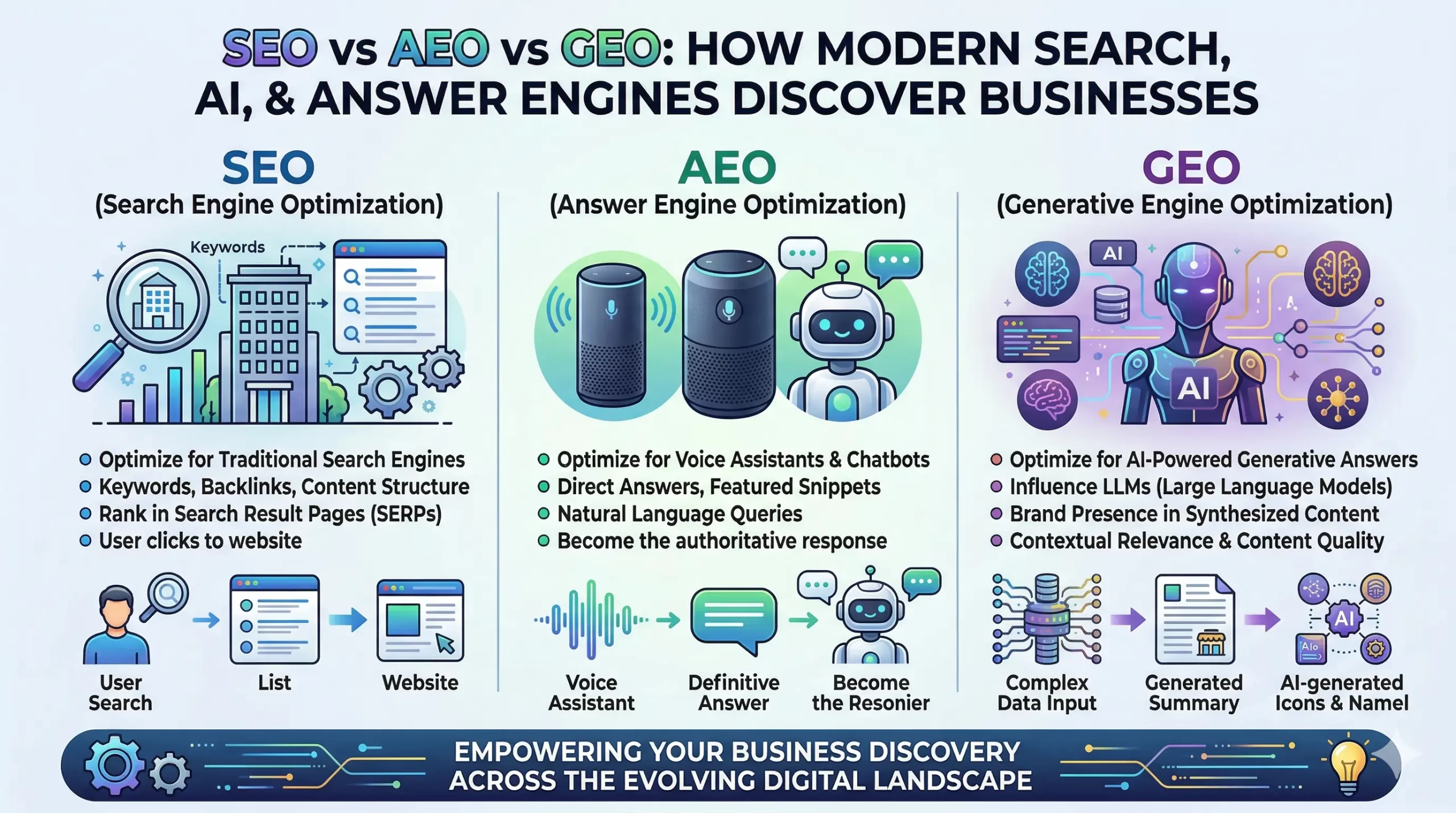
An overview of traditional Search Engine Optimization (SEO), Answer Engine Optimization (AEO), and Generative Engine Optimization (GEO).
SEO, AEO, and GEO all help people discover your business online. But they do not work in exactly the same way.
SEO focuses on helping your website rank in traditional search results on Google and other search engines.
AEO focuses on helping your content appear as the direct answer in featured snippets, voice search, FAQ sections, and answer boxes.
GEO focuses on helping AI tools understand, trust, summarize, and reference your content in AI-generated responses.
The easiest way to think about it is this:
- SEO helps people find your website
- AEO helps people find your answer
- GEO helps AI tools find and reference your business
They also overlap.
For example, a page with strong SEO usually has a better chance of appearing in AEO results because Google already sees it as useful and trustworthy.
A page with strong AEO structure may also perform better in GEO because AI tools prefer content that is easy to scan, easy to understand, and written in question-and-answer format.
Here is a simple breakdown:
- SEO is mainly about keywords, backlinks, technical SEO, and rankings
- AEO is mainly about question-based content, direct answers, FAQ sections, and featured snippets
- GEO is mainly about structured content, topical authority, trust signals, and AI visibility
You can also think of them by where they appear:
- SEO appears in traditional search results
- AEO appears in answer boxes, voice assistants, and snippets
- GEO appears in AI tools like ChatGPT, Gemini, and Perplexity
A business does not need to choose one over the other.
The strongest strategy is to use all three together.
For example, if you publish a page called “What Is Story-Driven Web Design?” you can:
- Use SEO to rank for the keyword
- Use AEO to answer common questions about story-driven design
- Use GEO to help AI tools summarize and reference the page
That is why SEO, AEO, and GEO should not be seen as separate strategies. They work best when combined.
Why Search Is Changing
Search does not work the same way it did a few years ago.
People are no longer only typing short keywords into Google and clicking through multiple websites.
Today, many people want answers immediately.
Google now shows AI Overviews for many searches. Instead of only showing a list of websites, Google often creates a summary at the top of the page using information from different sources.
Voice search is also growing.
People ask questions through Siri, Alexa, Google Assistant, and their phones in a more natural way. Instead of typing “best CRM software,” they may ask, “What is the best CRM for a small business with five employees?”
Chat-based search is growing too.
Many people now use tools like ChatGPT, Gemini, and Perplexity instead of traditional search engines.
Instead of getting a list of links, they get a direct answer, summary, recommendation, or comparison.
That means people are clicking less and reading summaries more.
People also search differently on mobile now. Many users do not scroll far down the page. If Google already gives them a quick answer through an AI Overview, featured snippet, or FAQ result, they may never visit another website.
This is called a no-click search.
For businesses, this creates a big shift.
A few years ago, ranking on page one of Google was often enough.
Now, a business may rank well but still miss out on visibility if its content is not showing up in featured snippets, voice search, AI Overviews, answer boxes, and AI-generated responses.
Traditional SEO still matters. But relying only on keywords and rankings is no longer enough.
Businesses that only focus on ranking may fall behind businesses that also create question-based content, strong FAQ sections, direct answers, and AI-friendly pages.
The businesses that stay visible in the future will be the ones that do more than rank.
They will be the ones that explain topics clearly, answer questions directly, and make their content easy for both people and AI tools to understand.
How AI Tools Discover Businesses
AI tools do not choose businesses randomly.
Tools like ChatGPT, Gemini, Perplexity, Claude, and Copilot all look for patterns when deciding which businesses, websites, and pages to mention.
They usually prefer businesses that explain topics clearly and consistently.
If your website is confusing, poorly structured, or says different things on different pages, AI tools may not trust it.
Structured content is one of the biggest factors.
AI tools prefer pages with:
- Clear headings
- Short paragraphs
- Bullet lists
- FAQ sections
- Tables
- Simple definitions
This makes it easier for AI systems to understand what your page is about.
For example, a page called “What Is SEO?” with a short definition, a few clear headings, and a FAQ section is much easier for AI tools to use than a long page with no structure.
Clear answers matter too.
AI tools often look for pages that answer a question directly in the first few lines.
For example, if someone asks “What is GEO?” the strongest pages usually define GEO immediately instead of making people scroll through long introductions.
Brand authority also matters.
AI tools are more likely to trust businesses that regularly publish helpful content around the same topic.
If your business writes one article about SEO and then never mentions it again, that may not build much authority.
But if your website includes content about SEO, AEO, GEO, AI search, website strategy, content structure, and answer engines, it creates a much stronger signal.
Trust signals are another major factor.
AI tools are more likely to reference businesses that show:
- Real author names
- Clear About pages
- Reviews and testimonials
- Case studies
- Updated information
- Consistent branding
- Contact details
- Industry expertise
AI tools also look for consistency across your website.
If one page says you are a web design company, another says you are a marketing agency, and another says you only focus on SEO, it can create confusion.
Strong businesses repeat the same core message across their homepage, service pages, blog posts, and About page.
Internal linking matters too.
When you connect related pages together, you help AI tools understand how topics relate to each other.
For example, a page about GEO could link to pages about SEO, AEO, AI Overviews, internal linking, and structured content.
That gives AI systems more context.
AI tools also trust businesses that go deeper into a topic.
A single article about SEO may not be enough. But if your website has several related articles around SEO, AI search, answer engines, website content, and brand authority, it becomes easier for AI tools to see you as a trusted source.
Consistent expertise is often what separates strong websites from weak ones.
AI tools usually trust businesses that stay focused on a few core topics and explain them well across multiple pages.
The businesses that win are often not the loudest. They are the clearest.
If your content is easy to understand, easy to trust, and easy to connect together, AI tools are more likely to discover and reference your business.
What Businesses Should Do Now
Most businesses do not need to rebuild their website from scratch.
But they do need to adjust how they create content.
The first step is to create better content.
That means writing pages that are useful, easy to understand, and focused on real customer questions.
Instead of writing generic blog posts, focus on topics your audience actually wants to know about.
The next step is to answer questions directly.
Use headings like:
- What is SEO?
- How does GEO work?
- Why do AI tools choose some websites over others?
Then answer those questions clearly in the first few lines.
Businesses should also build topical authority.
Instead of publishing random content on different subjects, focus on a few core topics and go deeper into them.
For example, if your business focuses on web design, you could publish related content about story-driven websites, SEO, AEO, GEO, branding, user experience, and conversion-focused design.
One good example is “What Is Story-Driven Web Design? A High-Converting Website Design Strategy Explained” because it helps build authority around web design, messaging, user experience, and conversions.
You can also link to “What Makes a Website High-Converting? Psychology, Structure, and Conversion Principles” because it supports topics like user experience, trust, page structure, and conversion-focused design.
Internal linking matters too.
Link related pages together so both Google and AI tools can understand the relationship between topics.
A page about GEO should naturally link to pages about SEO, AEO, AI Overviews, and AI search.
It is also important to publish trustworthy pages.
Use real author names, case studies, reviews, testimonials, updated information, and a clear About page.
Trust matters more now because AI tools want to recommend businesses that look reliable.
Most importantly, businesses need to think beyond Google rankings.
Ranking well is still valuable, but it is no longer the only goal.
Your content should also be able to appear in featured snippets, voice search, answer boxes, AI summaries, and AI-generated search results.
Final Takeaway
Search is no longer only about ranking on Google.
People now discover businesses through search engines, AI tools, voice assistants, featured snippets, and direct answers.
That is why SEO alone is no longer enough.
Businesses need content that ranks well, answers questions clearly, and helps AI tools understand and trust their expertise.
SEO helps people find your website.
AEO helps people find your answers.
GEO helps AI tools reference your business.
The businesses that stay visible in the future will be the ones that explain topics clearly, publish useful content, and build trust over time.
The future of discovery is not only about ranking.
It is about becoming the best answer.
The post SEO vs AEO vs GEO: How Modern Search, AI, and Answer Engines Discover Businesses appeared first on Best Media Agency.
]]>TL;DR
Answer Engine Optimization (AEO) is about shaping your content so AI tools, voice assistants, and search engines can extract and deliver direct answers. Unlike SEO, which ranks pages, AEO focuses on concise Q&A formats, schema, and natural language that fit conversational queries. In 2025, AEO matters because more people rely on voice search and AI summaries instead of clicking links. Clear headings, short answers, and structured FAQs help you capture visibility in this no-click world.
What Is Answer Engine Optimization (AEO)?
Answer Engine Optimization (AEO) is the process of shaping content so that AI tools, voice assistants, and search engines can extract and deliver direct answers. Instead of focusing only on ranking a webpage like traditional SEO, AEO makes sure your information is short, clear, and structured in a way that machines can understand.
AEO works by turning your content into question-and-answer blocks that fit how people actually search. For example, if someone asks, “What is AEO?”, the goal is for your content to be the exact snippet an assistant like Siri or ChatGPT pulls into its reply.
This makes AEO different from SEO. While SEO (Search Engine Optimization) is about visibility through links, AEO is about visibility through answers. Both work together, but AEO has become more important in 2025 because more searches end with a spoken or AI-generated response instead of a website click.
AEO vs SEO: What’s the Difference?
Answer Engine Optimization (AEO) and Search Engine Optimization (SEO) share a goal: making content easy to find. But they work in different ways. SEO is about helping a webpage rank higher in traditional search results. AEO is about making sure your content can be pulled into a direct answer by AI tools, voice assistants, or search engines.
Think of it this way: SEO points users to your site, while AEO puts your answer directly in front of them. Both are important, but they serve different stages of user intent.
Here’s a quick comparison:
| Aspect | SEO | AEO |
| Goal | Rank web pages in search results | Deliver direct answers in AI and voice results |
| Format | Full articles, blogs, pages | Short Q&A blocks, FAQs, schema |
| User Action | Clicks through to a website | Gets an instant answer |
| Core Tools | Keywords, backlinks, on-page SEO | Question-based headings, concise answers, structured data |
AEO doesn’t replace SEO. Instead, they complement each other. A site that performs well in both is more likely to show up whether a user clicks links or asks an assistant for help.
Why AEO Matters in 2025 and Beyond
Search behavior is shifting fast. More people use voice assistants and AI tools instead of typing queries into Google. Instead of scanning a page of blue links, they now expect a clear, instant answer. This is where Answer Engine Optimization (AEO) becomes critical.
If your content is structured for AEO, your brand can show up in the moment of the answer, even if the user never clicks a website. That means visibility, credibility, and reach in a world of “no-click” searches.
Benefits of AEO in 2025:
-
More visibility – appear directly in AI and voice responses.
-
Brand authority – being the chosen answer builds trust.
-
Adaptability – future-proofs your content for AI-first platforms.
-
Efficiency – short, structured content works better for both humans and machines.
Real-world example: When someone asks Alexa, “What is AEO?”, it doesn’t read out ten links. It reads one short, structured answer. If your content provides that answer, your brand gets the exposure.
Core Mechanisms Behind AEO
Answer engines don’t read the web like people do. They look for clear signals in your content that tell them “this is the answer.” The following mechanisms make that possible:
-
Q&A format – Structure your content so each question is followed by a short, direct answer.
-
Headings as questions – Use H2s and H3s phrased exactly how users search, such as “What is AEO?”.
-
Concise answer blocks – Keep responses short and factual. A single paragraph of 40–60 words works better than long explanations.
-
Schema – Apply FAQPage or HowTo schema so engines know your content is answer-ready.
These elements guide how AI and search systems extract answers. Without them, even strong content may get overlooked.
Real-world example: If you publish a blog with the heading “How does schema help AEO?” followed by a 50-word answer and proper FAQ schema, Google is more likely to pull that snippet directly into its results.
For more context on how this connects to AI-driven retrieval, see our guide on Generative Engine Optimization (GEO)
Key Components of Effective AEO
Answer Engine Optimization works best when content follows a few simple but powerful practices. These components help make your content more visible to AI systems and voice search.
Identifying High-Value Question Keywords
Start by finding the exact questions people ask. Tools like SEMrush or AnswerThePublic highlight queries such as “What is AEO?” or “How does schema help AEO?”. Audience FAQs, support emails, and comments can also be rich sources of question keywords.
Real-world example: If customers keep asking “How do I optimize my blog for AI answers?”, that’s a signal to create a dedicated Q&A block.
Structuring Content with Question Headings and Answer Blocks
Each heading should mirror the way people phrase searches, and each answer should be short, clear, and factual. A 40–60-word paragraph is often enough.
Real-world example: Instead of writing a long intro, use a heading like “What is AEO vs SEO?” and answer it in the next two sentences. This format improves your chance of being selected.
Implementing FAQ/QAPage Schema
Schema tells machines what your content represents. Adding the FAQPage or QAPage schema makes your Q&A blocks discoverable by answer engines. Without a schema, your content may never be recognized as answer-ready.
Real-world example: A local business adding FAQ schema to “What are your opening hours?” makes it more likely Google will display that answer directly in search.
Enhancing Voice and Conversational Contexts
Voice assistants prefer short, natural phrases. Write answers the way people speak, not the way textbooks read. Keep sentences simple and avoid jargon.
Real-world example: Alexa is more likely to read “AEO is a way to make content answer-ready for AI” than a long, complex definition.
Integrating AEO into Your Content Workflow
Answer Engine Optimization is not a one-time task. It works best when you build it into your content workflow from the start. Here’s a simple process:
-
Research – Collect real questions from tools, forums, and customer FAQs.
-
Draft – Write clear, direct answers of 40–60 words.
-
Add schema – Mark up Q&A blocks with FAQPage or QAPage schema.
-
Test – Check how your content appears in Google and voice assistants.
-
Monitor – Track impressions, snippets, and voice mentions.
-
Refine – Update and shorten answers as queries evolve.
Examples / Mini Case
Sometimes the difference between traditional writing and AEO-ready content is just structure. Here’s a quick example:
| Before | After (AEO-Friendly) |
| “Our company believes in the value of AEO. It is a growing trend in digital marketing, and if you apply it correctly, your website can benefit in terms of visibility and performance.” | Q: What is AEO? AEO, or Answer Engine Optimization, is the process of structuring content so AI tools and voice assistants can extract and present direct answers. |
The second version is short, clear, and structured as a Q&A. This makes it easier for both users and answer engines to understand and reuse.
Common Challenges and Pitfalls
Even when the basics of AEO are clear, small mistakes can reduce visibility. Common issues include:
-
Overly long answers – if your response runs several paragraphs, it may not be selected.
-
Missing schema – without FAQ or QAPage schema, engines may overlook your content.
-
Jargon-heavy text – complex phrasing makes it harder for AI and users to understand.
Avoiding these errors improves your chance of being the chosen answer. For more details, see Google’s official guidelines on structured data.
FAQ Section
What is AEO?
Answer Engine Optimization (AEO) is the practice of structuring content so AI tools, voice assistants, and search engines can extract and display direct answers instead of just linking to full web pages.
How do I find question keywords for AEO?
You can use keyword research tools like SEMrush, AnswerThePublic, or Google’s “People Also Ask” box. Reviewing customer FAQs, support tickets, or community comments also reveals real questions worth turning into AEO-friendly content.
How does schema help AEO?
Schema markup, such as FAQPage or QAPage schema, signals to search engines that your content is formatted for direct answers. This increases the chance your response will appear in featured snippets and voice results.
The post Answer Engine Optimization (AEO): What It Is and How It Differs from SEO appeared first on Best Media Agency.
]]>